
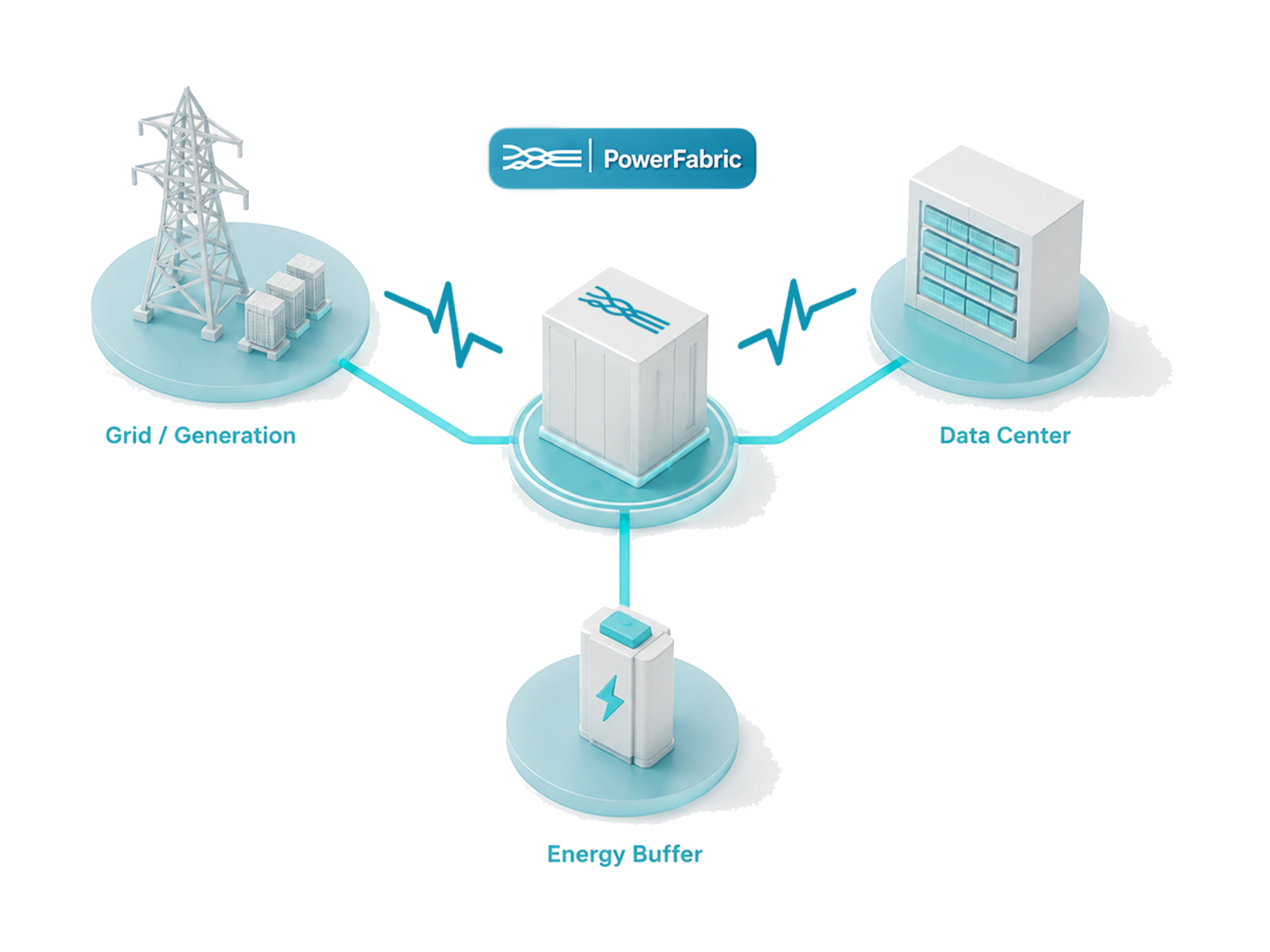
The PowerFabric architecture is TPS’s AI Power Protection Layer, built to help data centers manage fast-changing compute loads, onsite power, storage, and grid interaction as one coordinated system.
AI data centers are creating a new infrastructure challenge. It is no longer enough to secure megawatts. Sites also need power that can respond through rapid load changes, constrained interconnections, onsite generation dynamics, and mission-critical uptime requirements.
Highly dynamic AI loads change faster than today’s infrastructure was designed to manage, and that is what PowerFabric is built to address.
Real-time, sub-millisecond, power control for AI data center infrastructure
Built for power-constrained compute sites
Protection in both directions
Developed from TAE’s experience managing demanding power events in fusion applications
The next constraint for AI growth is not just power capacity. It is how productively that capacity can be used.
Rapid, multi-MW GPU load swings can occur on millisecond timescales, creating subcycle transients that traditional power infrastructure was not designed to manage.
Voltage, power-quality and stability disturbances can propagate in both directions: downstream to sensitive AI equipment and upstream to generation and electrical infrastructure.
Rising rack densities and campus scale are pushing legacy power architectures beyond their original design requirements, and the transition toward 800 VDC adds another architectural challenge.
Traditional UPS systems were designed for continuity and protection, not to actively manage highly dynamic AI loads and their interaction with upstream infrastructure.
For AI sites, the power system must do more than supply energy. It must manage volatility, protect uptime, and coordinate multiple power sources in real time.
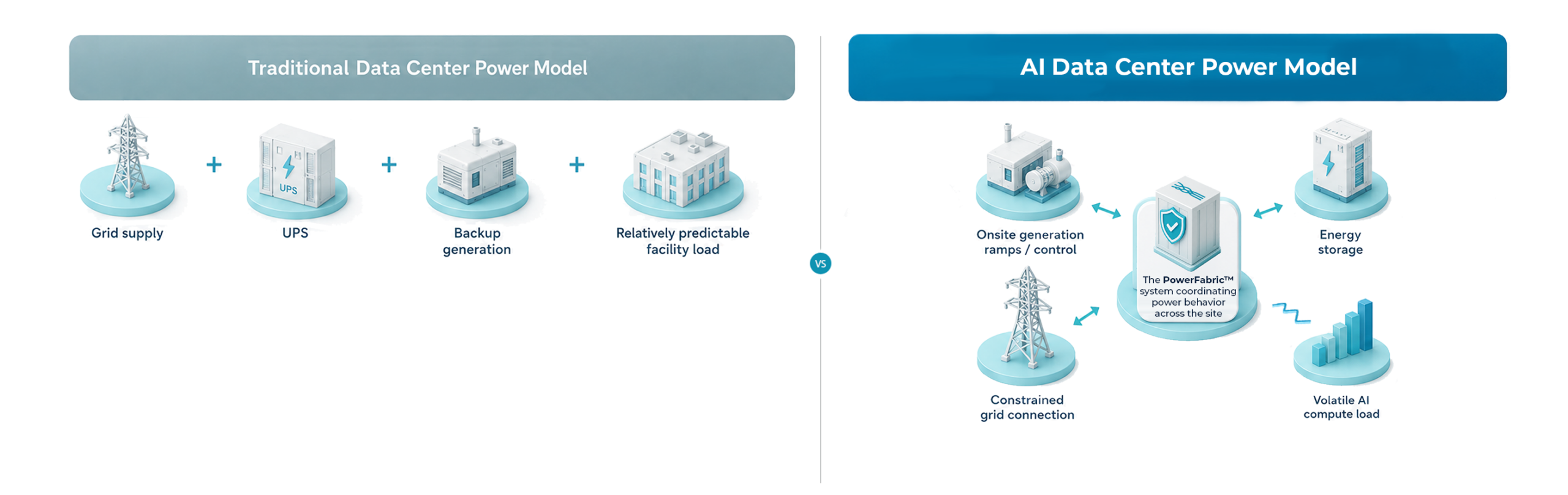
AI data centers and high-density compute infrastructure needs a new technology built for dynamic power control across the site
PowerFabric creates a controllable electrical interface between AI compute and upstream power infrastructure. It may perform or consolidate functions once handled by separate UPS and battery systems, but it is a different architecture, not a UPS with a battery attached.
The intelligent power control layer between AI compute and power infrastructure.
Controllable Interface:
a defined boundary between AI compute and upstream infrastructure
AI Load Decoupling:
controls the rate of change the power system sees
Protection in Both Directions:
shields the load and the grid
Built to Scale:
modular, transformerless, low-voltage architecture
The PowerFabric system combines multi-stage power conversion, energy storage integration, deterministic real-time controls, and site-level orchestration.
PowerFabric sits between AI compute and the power infrastructure that serves it. It synchronizes distributed power blocks as one coordinated system, with sub-millisecond control, and controls the rate of change the upstream power system sees.
The PowerFabric architecture is designed to help:
Smooth rapid compute-driven load changes
Coordinate grid, generation, and storage resources
Support voltage ride-through and resilience
Improve site-level power quality
Manage how large loads appear to the utility and power generation assets
Enable more responsive infrastructure planning
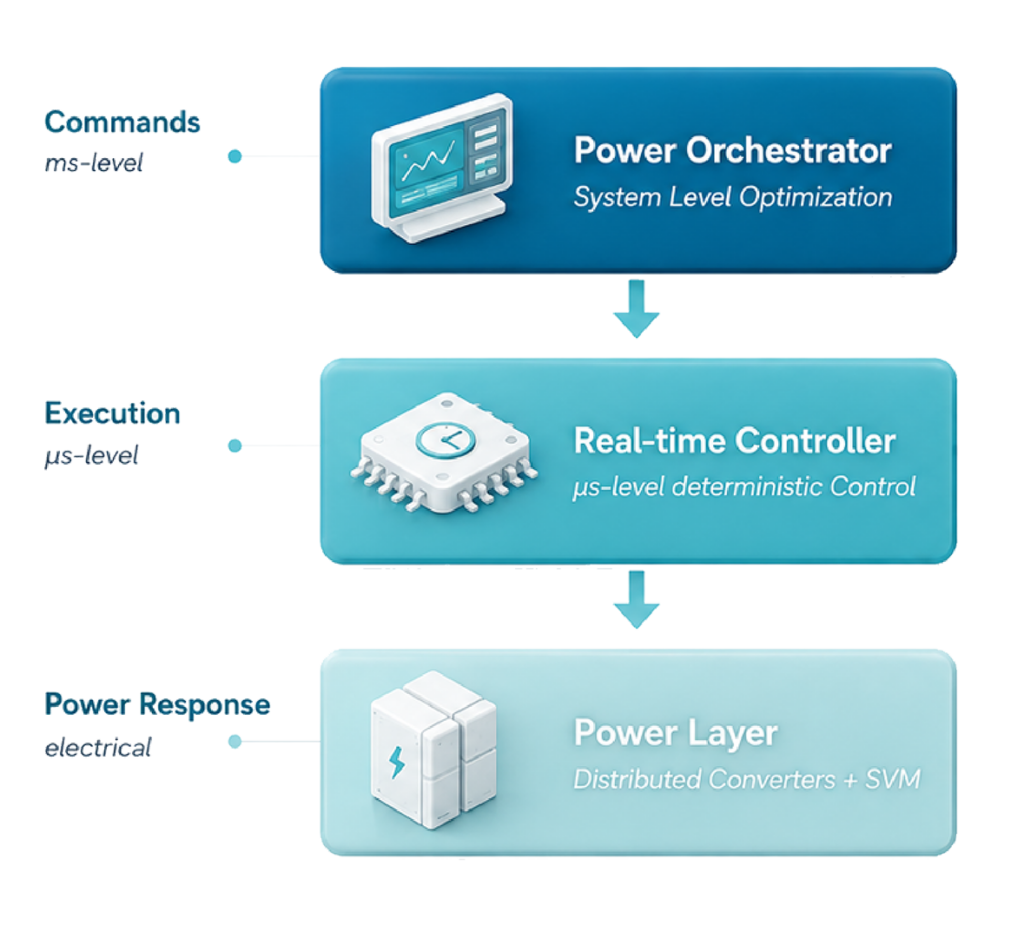
The PowerFabric architecture uses three coordinated layers to manage power from device-level execution to site-level optimization.
The PowerFabric solution is not a software overlay, a conventional inverter system, or a new wrapper around commodity storage. It is a layered architecture built for fast, coordinated response across complex power environments.
The system is organized around three coordinated layers:
The PowerFabric architecture is designed for the operating realities of AI data centers and other mission-critical power environments.
AI facilities need electrical systems that can respond to changing load profiles, grid conditions, storage behavior, and generation requirements.
PowerFabric is designed for the operating realities of AI data centers: rapid load swings, upstream disturbances, and the need to scale within constrained power.
Smooth AI-Driven Load Swings
Designed to support current and future AI load profiles, including training, inference, and emerging high-density compute architectures.
Match Practical Data Center Blocks
Developed around 2.5 MW modular power blocks to align with data center electrical architectures.
Support
Ride-Through
Designed to help sites operate through voltage events, disturbances, and transition periods.
Improve Bi-Directional Power Quality
Helps protect sensitive AI loads from upstream disturbances while protecting generation and power infrastructure from volatile AI loads.
Reduce Generator Stress
Helps maintain ramp-rate loading requirements for onsite generation without relying only on overbuild.
Stabilize Site
Operation
Enable Flexible Large Loads
Supports infrastructure that can respond more dynamically to operating and grid requirements.
Path to 800 VDC
Enables a modular, transformerless, low-voltage architecture that provides a path from today’s AC infrastructure toward emerging 800 VDC architectures.
The PowerFabric system fits where high-density compute, constrained grids, onsite power, and uptime requirements intersect.
The PowerFabric solution is designed for environments where electricity must be actively managed, not passively backed up. It helps coordinate the systems that matter most for AI growth: compute loads, onsite generation, storage, and utility supply.
For data center operators: manage load swings, disturbances, and power source transitions.
For developers: support more flexible planning in grid-constrained environments.
For utilities: Control the rate of change that large AI loads present to the grid.
For owners and investors: strengthen asset utilization, resilience, and infrastructure value.
For technical teams: Transformerless 3P4W, low-voltage architecture with modular deployment and deterministic real-time control.
Born from the pursuit of fusion, PowerFabric builds on TAE’s decades of experience developing high-speed, deterministic real-time controls for one of the world’s most demanding power-control environments.
The PowerFabric solution is not a marketing wrapper around commodity storage or conventional power conversion. It comes from a power control architecture TAE has spent more than 15 years developing for fusion systems, where high-energy events must be managed with precision, speed, and coordination.
That foundation maps directly to the PowerFabric solution stack: high-performance conversion, deterministic real-time control, and system-level orchestration.
Developed alongside top-tier industrial partners and now being applied with strategic customers, this experience gives PowerFabric system a unique path to serving the power demands of AI data centers, onsite generation systems, energy storage assets, and grid-constrained sites.
Fusion-Derived Foundation
Built on decades of TAE power control development for fusion.
Three-Layer Architecture
Connects high-performance conversion, deterministic control, and system orchestration.
Developed with Industry Leaders
Advanced alongside top-tier industrial partners and applied with strategic customers.
Beyond Commodity Storage
Designed to actively manage site operation, not just store energy.
Built for Grid Compatibility
Focused on power quality, uptime, and predictable grid-facing behavior.
Talk to TPS about your site constraints, AI power challenge, and infrastructure roadmap.
Planning new AI capacity, evaluating onsite generation, facing grid constraints, or designing for mission-critical resilience? TPS can help assess where PowerFabric fits into your power architecture.
Connect with our technical team to discuss your project goals, operating requirements, and deployment timeline.
Join our mailing list to stay up to date on the latest news